Mixing Oil and Water in Outer Space, do that separate into 2 layers?
When you pour oil to water in a beaker and shake well, oil droplets will disperse randomly in the water. After that, let the beaker and the mixture take a rest for a few hours, oil droplets will float to the top and water sink to the bottom and they are separated into 2 layers. Everybody should know this phenomenon but why is that so?
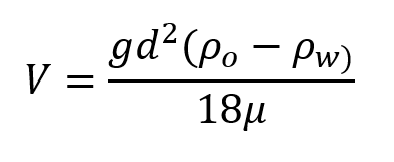
Oil and water are different materials but the key difference to let the oil/water mixture to separate is the density. The density of oil is around 0.91-0.93 g/cm3 while water is 1 g/cm3. The density of oil is smaller than water. Under the same Earth “Gravity”, higher density water is more attracted to the Earth center than the lower density oil. The rate of the separation can be estimated by Stokes’ Law. (1)
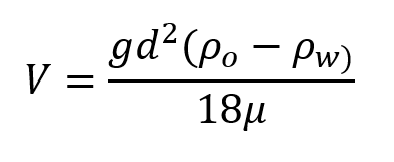
V = Rate of flow of oil droplets
g = Acceleration of gravity
ρo = Density of oil
d = Diameter of the oil droplets
ρw = Density of water
µ = Viscosity of water
As density of oil is smaller than water, the value of ( ρo – ρw) is negative and than the direction of oil droplets is floating up away from Earth centre of gravity. The larger the difference in the density, the faster the rate of separation.
Similarly, if we add sand to the water and shake well, the sand particles will suspense in the water evenly. After rest for few minutes, the sand particles will sink to the bottom forming pellet. Stokes’s Law is also applicable here. Density of sand is 2.0 g/cm3 and thus is higher than water. The value of ( ρs – ρw ) is positive and thus the sand particles will sink towards the centre of Earth.
Did I say “Gravity”? Yes, the gravity is the gravitational force acting on the 2 liquids that cause them to separated. It is same force we are feeling when standing on the Earth surface. The g value is 9.81 m/s2 on Earth Surface. How about if we want to separate the same oil/water mixture when we are in outer space where there is no gravity, i.e. g is 0? From Stokes’ Law, the formula will give V to 0 if g is 0. This means the rate of separation is zero and thus no separation!
Can we still separate the oil water mixture in 2 layers in outer space? Yes, we can! Use a centrifuge!
Centrifugation is a simple way to increase the rate of separation by increasing the effective gravitational force, hence the g value. Now the g value is not zero and oil and water separate as on Earth and is much faster!
- Stokes’ Law – Oil/Water Separator Theory of Operation – Hydroflotech
- Gravity value at different distances from the centre of Earth – How Does Gravity Work Underground? (An In-Depth Explanation) – Profound Physics
 SmarterScience